


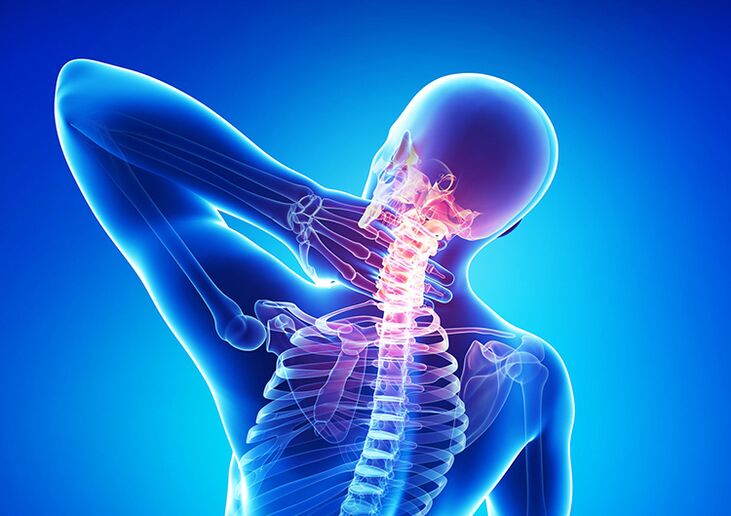
Osteochondrosis is included in the category of common disorders.In 75% of cases, it is what causes unpleasant back pain.Today, every second person after twenty years has manifestations of pathology.With age, the risk of developing the disease increases.If treatment is not started immediately, osteochondrosis can cause negative health consequences.
What is osteochondrosis of the spine
This process affects the articular cartilage and nearby bones.At first, osteochondrosis affects only the discs that hold the vertebrae together.The degenerative process then affects the ligaments and vertebrae, disrupting the integrity of the joints.
The insidious thing about the pathology is that the disc cartilage cannot regenerate.Therefore, the area of the spine affected by the disease will inevitably deteriorate.Once a disease appears, you can stop its growth, but it cannot be completely eliminated.
This pathology is not associated with inflammation - it is based on a violation of tissue nutrition and degeneration of their structure.In the absence of loads, the tissues lose their strength because they do not receive the required amount of nutrients.
Clinical features
The development of the disease leads to the fact that the pulp core dries out and partially loses its shock-absorbing characteristics.The fibrous ring becomes thinner and microcracks form on it.
As a result, a protrusion appears, called a disc protrusion.As the disease progresses, the annulus may rupture and then an intervertebral hernia is diagnosed.
This area loses its stability, osteophytes can form and the integrity of the ligaments and joints is compromised.To compensate for disc deformation, bone and fibrous tissue grow.In this condition, the spinal column becomes less mobile.
Usually the disease has periods of remission, which are then followed by relapses.
Degrees and stages
There are several degrees of the disease, each of which has the following characteristics:
- 1st grade.Due to imprecise movement, the disk breaks.This condition can also be caused by stress.Severe pain and a sensation reminiscent of an electric discharge often occur.
- 2nd grade.Spinal stability is lost and protrusions develop.There may be pain that increases with careless movements.This form of the disease is characterized by numbness of the fingers, headaches and transient discomfort in the sacrum.
- 3rd grade.This condition has manifestations of herniation, headaches and discomfort in the area of the damaged nerve.Also, hands and feet often go numb, vision and hearing deteriorate, and problems occur in the functioning of many organs.
- 4th grade.At this stage, the symptoms of a hernia disappear and the manifestations of the disease decrease.The spine loses stability, a condition characterized by slipping or twisting of the vertebrae.The vertebrae can grow, which causes compression of the nerves, causing the spinal canal to atrophy and the spinal cord to become compressed.The fourth degree is distinguished by the consequences that may occur after the removal of the hernia - these include paresis, inflammation, etc.
It is also common to distinguish certain stages:
- Yes,first stage- essentially a consequence of lack of moisture and loss of elastic properties.The disease is characterized by a displacement of the nucleus inside the disc, which leads to a disruption of the shape of the annulus fibrosus.However, the process itself remains within the intervertebral disc, without going beyond its limits.
- ForsecondlyThe formation of cracks in the ring is characteristic.As the flattened disc height decreases, there is a loss of spinal stability.
- Third stagecharacterized by the appearance of tears at the site of the cracks and the onset of inflammation.Part of the liquid core leaks through microcracks.Nerves or blood vessels are often compressed at the site of the tear.
- Fourth stageaccompanied by dystrophic processes.Vertebral segments do not provide the necessary resistance, so adjacent vertebral bodies move closer to each other.Complications can also occur.This can be the development of spondylosis and spondylosis.At this stage, flattening of the vertebra is observed - this happens to remove the load from the disc.Sometimes the fibrous tissue is replaced by bone.This stage is characterized by a temporary reduction in pain.However, afterwards the discomfort increases due to compression of the nerves and narrowing of the spinal canal.
Causes of the disease
This disease can be detected in both old and young people.Typically, signs of osteochondrosis appear around the age of thirty-five.The development and recurrence of the disease is caused by overload, back injuries and vibrations.As the body ages, more and more symptoms appear.The exact causes of the disease have not yet been ascertained.
The most popular opinion is that the process is a consequence of incorrect distribution of the load on the spine due to weakness of muscles and ligaments.This theory is also proven by popular methods of treatment, which are based on the training of the muscular system and ligaments.
Factors that can cause an abnormal process in the spine include:
- bad posture;
- overweight;
- injuries;
- flatfeet?
- curvature of the spine;
- metabolic disorders;
- infections;
- heredity;
- poor physical condition;
- stress;
- heavy loads;
- hormonal imbalance;
- poor diet;
- poor environmental conditions;
- systematic influence of vibrations.
- age-related changes;
- sedentary lifestyle;
- hypothermia;
- smoking;
- spine abnormalities.
Even if a person leads a normal life, he is at risk of developing osteochondrosis due to a lack of essential substances.In modern society, this problem is considered one of the main ones.The condition is aggravated by an inactive lifestyle.
Types and symptoms
Depending on the area of damage, there is cervical, thoracic or lumbar osteochondrosis.If several departments are involved in the pathological process at the same time, we can talk about a common form.
Since the lower back usually bears the greatest load, lumbar osteochondrosis dominates among all cases of the disease - its prevalence is about 50%.
In second place is the cervical area.This form of osteochondrosis is diagnosed in a quarter of cases.This disease is usually the result of prolonged sitting at the computer or monotonous work.
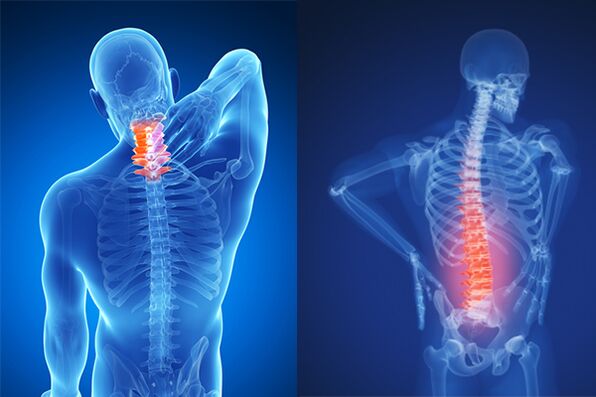
Thoracic osteochondrosis is extremely rare and is usually associated with limited range of motion.
General signs of the disease
The pathology has different signs that directly depend on the location of the process:
- Pain in the spine.Sometimes osteochondrosis causes mild pain or nagging pain.The disease can also cause sharp, unbearable pain - it is difficult to eliminate with non-narcotic analgesics.
- Deterioration of vision or hearing.
- Headaches.The disease often causes a feeling of weakness, dizziness and increased fatigue.
- Loss of sensitivity.This symptom usually manifests itself as numbness in the hands or feet.
- Problems in the functioning of the pelvic organs and sexual dysfunction.
- Loss of mobility in the problem area.
- Problems with organs for which the spinal cord is responsible.
- Pain in arms and legs.
- Muscle weakness.
How is cervical osteochondrosis manifested:
- systemic headaches;
- hearing loss;
- dizziness;
- pressure surges;
- voice change;
- impaired vision;
- snore;
- tooth wear.
Symptoms of breast form:
- high fatigue of the back muscle tissue.
- pain on palpation;
- back and chest pain;
- problems with various organs.
Manifestations of lumbar osteochondrosis:
- Pain in the back;
- numbness of the legs;
- decrease in skin temperature.
- urinary disorder;
- muscle tension;
- stool problems;
- varicose veins;
- loss of activity.
Complications
Osteochondrosis often causes complications, so this disease cannot be ignored.The consequences of the disease include:
- Lumbago - severe pain in the lower back.
- Intervertebral hernia.
- Projection.
- Rhizitis.
- Migraine attacks.
- Spondylosis.
- Sciatica is a pathology of the sciatic nerve that causes pain in the legs and buttocks.
- Narrowing of the spinal canal.
- Phytovascular dystonia.
- A Schmorl's hernia is a protrusion of a disc into the vertebral cavity.
The most dangerous complication of osteochondrosis is considered to be compression of the arteries that supply food to the brain.Due to these trunks, the brain is supplied with blood.Due to nutritional deficiency, more serious pathologies may develop.
Diagnostics
Diagnosis is based on medical history and examination.It also requires an assessment of neurological status.Additional tests include:
- magnetic resonance imaging;
- Doppler ultrasound?
- Spondylography?
- computed tomography.
Thanks to these studies, it is possible to determine the level of violations, clarify the diagnosis and identify hidden processes.This allows you to choose effective treatment and achieve good results.
Treatment methods

At an early stage, conservative treatment is the best option.The doctor prescribes medicine.Therapeutic exercise can also be used.Manual therapy and reflexology are very helpful.
Among the drugs, non-narcotic analgesics and sedatives are considered the most effective.You should also take medication with B vitamins. Usually, this treatment is used during a relapse of the disease to eliminate pain and inflammation.
Reflexology involves the use of methods such as paraffin baths, laser therapy, acupuncture, electrical stimulation and ultrasound.No less useful are mud baths and iodine therapy.
The therapeutic exercise aims at strengthening the muscular system and releasing the nerve endings.In difficult cases it is impossible to do without surgery.If conservative treatment is ineffective, the hernia must be removed.This can be achieved by the classical or microsurgical method.
Osteochondrosis is a dangerous disease that causes pain and leads to loss of motor activity.
To stop the development of complications, at the slightest discomfort in the spine area, you should consult a doctor.Only a specialist will be able to make the correct diagnosis and choose treatment.